Harnandipuram Ghaziabad New Update Today
Posted By
Harnandipuram Ghaziabad
Date
May 31, 2026
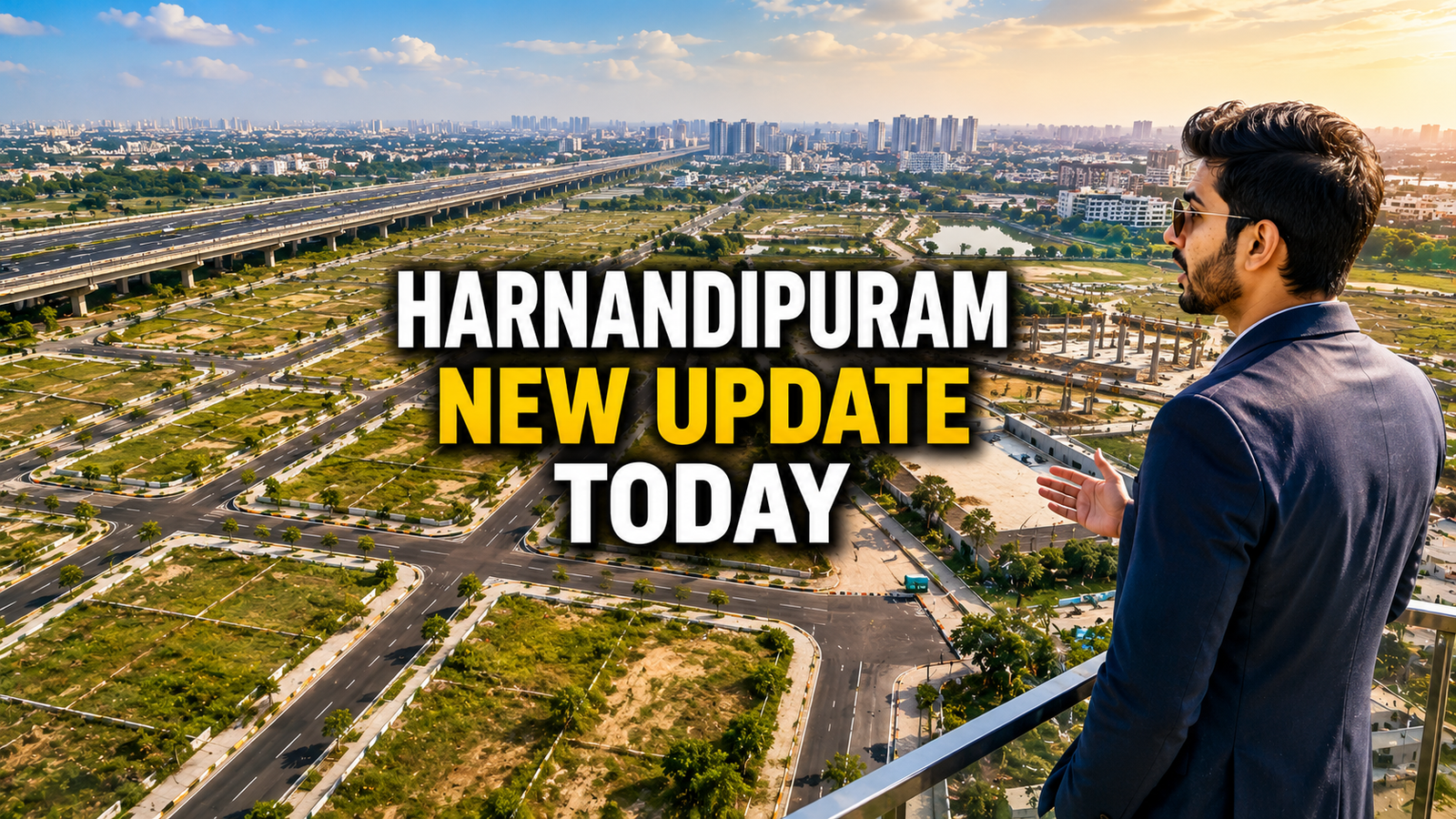
If you have been tracking Ghaziabad's most talked-about real estate development, you already know that Harnandipuram has been generating more buzz than any other project in the Delhi NCR region right now. Property buyers, plot investors, NRIs, and first-time homebuyers are all searching for one thing: what is the latest Harnandipuram update today?
The reason for the curiosity is straightforward. This is not a private builder's project with glossy brochures and speculative timelines. Harnandipuram is a government-backed township being developed directly by the Ghaziabad Development Authority (GDA) under the UP Chief Minister's Urban Expansion New City Promotion Scheme. That makes every official announcement count.
In this update, we break down everything that has happened in 2025 and 2026 so far — from the DPR appointment and drone surveys to land acquisition numbers, infrastructure planning, and what all of this means for buyers and investors.
Latest Harnandipuram Ghaziabad Update at a Glance
Here is a quick snapshot of where the Harnandipuram project stands right now:
- Total area: 521 hectares (approximately 1,287 acres) spread across 8 villages
- Land acquisition: Over 130 hectares secured; Phase-1 registries for approximately 82 hectares already completed
- DPR Consultant: A private agency appointed by GDA; DPR work is actively underway
- Drone Survey: Completed using drone and satellite imagery for layout and planning purposes
- Phase 1 Launch: Expected in Q3 2026 once 100–120 hectares of land are formally secured
- GDA Presentation: A Harnandipuram township presentation was held on December 30, 2025 at GDA's office
- Master Plan Inclusion: The 521-hectare land has been officially included in the Ghaziabad Master Plan 2031
- Total project cost estimate: Rs 10,000 crore (land acquisition alone estimated at Rs 2,384 crore to Rs 5,000 crore)
The project is moving in clear, measurable steps. For buyers who have been sitting on the fence, these milestones signal that the window for early-stage positioning is narrowing.
What's New in Harnandipuram?
DPR Consultant Appointed — The Most Critical Step
The single most important development in 2025 was the appointment of a private consultant agency by GDA to prepare the Detailed Project Report (DPR) for Harnandipuram. This happened after GDA invited tenders in April 2025 and held a technical presentation for shortlisted firms on April 16, 2025.
The selected agency is working on a comprehensive DPR that will cover roads, sewerage, water supply lines, electricity networks, green belts, commercial zones, and the overall layout of the township. The first draft of the DPR was expected within two months of the agency's appointment, placing it around July–August 2025. GDA will review, suggest modifications, and finalize the plan before physical development work is officially launched.
In the first phase, planning work will focus on nearly 100 hectares of land. Once GDA approves the final DPR, ground-level construction work will begin in an organized manner.
Land Acquisition Progress — The Numbers Are Moving
GDA has been acquiring land at 4x the official circle rate — a model designed to keep the process farmer-friendly, dispute-free, and legally clean. According to the latest reports, over 130 hectares of land have already been secured, with phase-1 registries for approximately 82 hectares formally completed.
The authority is negotiating with farmers across eight villages: Mathurapur, Shamsher, Champat Nagar, Bhowpur, Nagla Ferozepur, Morta, Atour, and Shapur Morta. Officials have been conducting negotiations at the rate of 2–3 hectares per day — a steady pace that reflects both the ambition and the challenges of acquiring land at this scale.
In a farmer-friendly innovation, GDA is also offering landowners 10% of the developed land back once infrastructure is built. This gives farmers a long-term stake in the project's success and significantly reduces resistance to acquisition — a model that has been implemented on a broader scale here for the first time in the region.
Drone Survey Completed
A full drone and satellite imagery survey of the proposed Harnandipuram area has been completed. This data is being used to prepare accurate topographic maps, plan internal road grids, identify natural drainage paths along the Hindon River corridor, and finalize the township's sector-level layout. The survey ensures that the DPR is built on accurate ground-level data rather than assumptions.
GDA Presentation on December 30, 2025
The GDA's official archive confirms that a dedicated Harnandipuram presentation was held on December 30, 2025. This internal review is part of the authority's structured process of tracking progress, gathering expert input, and refining plans ahead of the formal Phase 1 announcement. The fact that GDA is holding scheduled reviews signals institutional seriousness about the project timeline.
Inclusion in Ghaziabad Master Plan 2031
One of the most significant formal milestones is the official inclusion of the 521-hectare Harnandipuram land in the Ghaziabad Master Plan 2031. This is not a minor administrative step. Master plan inclusion means the land is legally earmarked for urban development, giving buyers, investors, and financial institutions the assurance that no future legal challenge can derail the project's zoning status.
Infrastructure and Connectivity Updates
One of the strongest arguments for Harnandipuram is not just the housing it will provide — it is where it sits on the map.
Delhi–Meerut Expressway (NH-58)
The township is being planned adjacent to the Delhi–Meerut Expressway (NH-58), one of the busiest and best-maintained arterial roads in the NCR. This gives residents and businesses within the township near-instant access to both Delhi and Meerut without navigating through congested city roads.
Namo Bharat RRTS Corridor
Perhaps the most exciting connectivity asset for Harnandipuram is its proximity to the Rapid Rail Transit System (RRTS) — India's first semi-high-speed rail corridor connecting Delhi, Ghaziabad, and Meerut. The township is located within 2 to 3 kilometres of the Duhai Depot RRTS station. This means residents will be able to reach Delhi in under 15 minutes on the Namo Bharat trains, making Harnandipuram viable as a primary residence even for people working in central Delhi.
2-km Elevated Link Road to Hindon Corridor
GDA's infrastructure plans include a 2-kilometre elevated link road that will directly connect Harnandipuram to the Hindon corridor. This road will eliminate multiple traffic signal stops and is expected to reduce travel time to Delhi to just 10–12 minutes under normal conditions — a significant advantage over most other township projects in comparable price brackets.
Raj Nagar Extension Road Widening
GDA is simultaneously widening key roads in the adjoining Raj Nagar Extension area. This road-widening initiative is designed to ease current traffic pressure and create smooth approach routes to the new Harnandipuram township. This is complementary infrastructure — even before the township is ready, the region's road capacity is being upgraded.
Eastern Peripheral Expressway Access
Beyond the RRTS and Delhi–Meerut Expressway, the township also benefits from proximity to the Eastern Peripheral Expressway, which connects NH-44 in the north to NH-19 in the south, offering logistics and commercial connectivity across a wide corridor of the NCR.
Planned Special Zones Within the Township
The Harnandipuram master plan includes dedicated zones for a Medi City (healthcare hub), Edu City (educational institutions), Cyber City (IT and technology offices), and a Sports City. This is not a standard plotted colony. GDA has studied urban planning models internationally and is designing Harnandipuram as a self-sufficient urban ecosystem — comparable in ambition to GIFT City in Gujarat, though scaled and positioned differently for the NCR market.
How These Updates Impact Property Buyers
For end-users — people who want to buy a plot, build a home, and settle in a well-planned area near Delhi — the latest Harnandipuram updates carry several practical implications.
Government-backed certainty: Since this is a GDA project, buyers do not face the risks associated with private developers — stalled projects, arbitrary price hikes, or title disputes. The land acquisition model at 4x circle rates, combined with master plan inclusion, ensures a legally clean product.
Affordable entry into NCR: For buyers priced out of fully developed Ghaziabad areas like Indirapuram, Vaishali, or Kaushambi, Harnandipuram offers a genuine opportunity to secure a plot in the same macro-zone at significantly lower rates. This is especially relevant for middle-income families in the NCR.
Infrastructure before handover: Unlike many private townships where infrastructure promises remain on paper for years, the DPR process for Harnandipuram is specifically designed to lay roads, drainage, water, and electricity networks before residential allotment — meaning buyers will receive a plot in a functional, not aspiring, township.
RERA compliance: RERA registration for the scheme is expected to be completed in the coming months ahead of Phase 1 launch. Buyers will have full regulatory protection once the scheme goes live.
How These Updates Impact Investors
For property investors — whether salaried professionals looking for a second asset, NRIs seeking a safe NCR land investment, or active real estate investors — the Harnandipuram trajectory offers a compelling case.
Pre-launch pricing advantage: The current phase — land acquisition and DPR finalization — is widely considered the most advantageous entry point. Once the official GDA brochure is released (expected Q3 2026) and allotments begin, prices in and around the township will adjust upward. Buying adjacent or early-phase plots at pre-launch valuations is a strategy that has historically rewarded investors in GDA townships like Indirapuram and Madhuban Bapudham.
Infrastructure-driven appreciation: The combination of RRTS proximity, the Delhi–Meerut Expressway, the Eastern Peripheral Expressway, and the planned elevated link road creates a multi-vector connectivity advantage. Real estate appreciation in NCR has consistently followed infrastructure development. Harnandipuram sits at the intersection of three major infrastructure projects simultaneously.
Demand-supply dynamics: Ghaziabad currently has a significant backlog of housing demand. The UP government itself acknowledged this, with approximately 10,000 GDA and UP Housing Board flats remaining unsold — but that inventory mismatch is for high-rise apartments in already-saturated zones. Harnandipuram offers something different: planned plotted development and low-rise housing in a new greenfield township, a product category that has sustained demand in the NCR.
Institutional confidence: The Rs 1,200 crore proposed for land acquisition in the coming financial year, supported by both state government funds and GDA resources, confirms that this is a well-funded project with institutional backing at the highest level.
Harnandipuram vs Earlier Project Status — Comparison Table
| Area / Parameter | Previous Status (2024) | Current Update (Mid-2026) |
|---|---|---|
| Land Acquisition | 6-member GDA panel formed; negotiations just beginning; deed agreements for 35 hectares signed | Over 130 hectares secured; Phase-1 registries for ~82 hectares completed; daily acquisition of 2–3 hectares ongoing |
| DPR Preparation | Tender for DPR consultancy floated in April 2025; firms invited for technical presentation | Private consultant appointed; DPR actively underway; first draft focused on 100-hectare Phase 1 layout |
| Township Survey | Ground survey in progress; map vetted by GDA in August 2024 | Full drone and satellite imagery survey completed; topographic data feeding into DPR |
| Master Plan Status | Proposed for inclusion in Ghaziabad Master Plan 2031 | Officially included in Ghaziabad Master Plan 2031 |
| Farmer Consent Model | Compensation at 4x circle rate announced; committee formed to assess market rates | 10% developed land-back model introduced alongside cash compensation; farmer resistance reduced |
| Phase 1 Launch Timeline | Targeted for Q1 2025 (subsequently revised) | Expected Q3 2026 upon securing 100–120 hectares and completing RERA formalities |
| Elevated Road Connectivity | Planned; alignment not finalized | 2-km elevated link road to Hindon corridor confirmed; Raj Nagar Extension road widening underway |
| RRTS Proximity | Township location identified near RRTS corridor | Township confirmed within 2–3 km of Duhai Depot RRTS station; Namo Bharat operational |
| Total Budget Allocation | Rs 5,000 crore estimated; state-GDA cost sharing announced | Rs 1,200 crore proposed for acquisition in current financial year; total project cost Rs 10,000 crore |
Why Buyers Are Paying Attention to Harnandipuram
Ghaziabad already has proven residential corridors — Indirapuram, Vaishali, Kaushambi, Raj Nagar Extension, and Crossings Republik. So what makes a new GDA township command so much attention when existing options are already available?
The answer lies in a combination of factors that rarely align simultaneously in any single NCR project.
Scale of planned amenities: Harnandipuram is not just a housing scheme. The master plan integrates a Medi City, Edu City, Cyber City, and Sports City — components that, once operational, make the township a self-contained urban environment. This reduces the dependence on external city infrastructure that has historically been the weak point of NCR townships.
Government-guaranteed title: For NRIs and first-generation property buyers who have heard too many stories about private builder defaults in NCR, a GDA township with direct land purchase from farmers at market-linked rates is as secure as real estate investment gets in India.
Comparisons with Indirapuram: GDA has explicitly positioned Harnandipuram as the next Indirapuram — a township that transformed Ghaziabad's urban profile and generated multi-decade wealth for early buyers. Indirapuram is now one of the most densely populated and commercially active corridors in the NCR. Early buyers there in the 1990s saw extraordinary appreciation. GDA is attempting to replicate that model with updated planning standards.
Clean slate, modern planning: Unlike many older townships that evolved organically and now struggle with infrastructure gaps, Harnandipuram is being designed from scratch with 21st-century standards for roads, utilities, and green spaces — including flood management measures given its proximity to the Hindon River.
Expert Analysis: What These Updates Mean for the Future
Let us be balanced and clear here. Harnandipuram is a government township project, which means it carries both the security of institutional backing and the pace associated with government timelines. The original Phase 1 launch was anticipated for Q1 2025 and has since been revised to Q3 2026. Buyers should factor in the possibility of further timeline shifts as land acquisition negotiations continue with the remaining farmers.
That said, the trajectory is positive. The DPR is being actively prepared. Drone surveys are done. Over 130 hectares are secured. The master plan inclusion is formal. And the UP government has shown political will to push this project — it is part of the Chief Minister's flagship Urban Expansion scheme and carries state-level priority.
From a property investment standpoint, the risk-return profile is asymmetric in the buyer's favour at this stage. The downside risk is timeline delay — you wait longer than expected. The upside potential is significant capital appreciation once the DPR is approved, Phase 1 is launched, and infrastructure construction begins publicly — events that generate media attention, buyer enquiries, and price movement.
The RRTS operational status is a game-changer that few analysts have fully priced into their Harnandipuram assessments. With Namo Bharat trains now running on the Delhi–Ghaziabad–Meerut corridor, the 2–3 km distance from Harnandipuram to the Duhai Depot RRTS station makes this township one of the best-positioned large-format developments in the entire NCR for transit-oriented urban living.
The key risk to monitor is land acquisition completion. The authority needs approximately 100–120 hectares formally in hand before Phase 1 can be launched. With 130 hectares already secured, GDA is close — but the remaining acquisition from unwilling farmers, if any, could extend timelines by another 6–12 months. Buyers and investors should track this metric specifically.
Common Questions About Harnandipuram Updates
Is Harnandipuram a government project?
Yes, completely. It is being developed by the Ghaziabad Development Authority (GDA), a statutory body under the Government of Uttar Pradesh. The project is part of the Chief Minister's Urban Expansion New City Promotion Scheme, with the state government and GDA jointly funding land acquisition costs.
When will Phase 1 of Harnandipuram be launched?
GDA officials have indicated a Phase 1 launch in Q3 2026, contingent on securing 100–120 hectares of land from farmers and completing RERA registration formalities. With 130 hectares already secured, the project is close to this threshold — but formal GDA announcement has not yet been made as of this update.
What types of properties will be available in Harnandipuram?
The township will offer residential plots, commercial plots, and industrial plots. The master plan also includes multistoried affordable housing. In addition, dedicated zones for healthcare (Medi City), education (Edu City), IT offices (Cyber City), and sports facilities (Sports City) are part of the overall framework.
Is it safe to invest near Harnandipuram before the official launch?
Investing in private plots near a government township always carries individual due diligence requirements. Verify the title, check for any GDA or district acquisition notices on the land, and confirm the plot is not within the acquisition zone. Engage a property lawyer familiar with GDA land records before any transaction. The GDA township itself will be a formally allotted product with legal protection once launched.
Frequently Asked Questions
1. What is the total area of Harnandipuram township?
The Harnandipuram township spans 521 hectares (approximately 1,287 acres) across eight villages near the Hindon River in Ghaziabad.
2. Who is developing Harnandipuram in Ghaziabad?
The project is being developed by the Ghaziabad Development Authority (GDA) under the UP Chief Minister's Urban Expansion New City Promotion Scheme. It is a 100% government-backed project — not a private developer initiative.
3. What is the Harnandipuram project status in 2026?
As of mid-2026, land acquisition has crossed 130 hectares, a private consultant has been appointed for the Detailed Project Report (DPR), drone surveys are complete, and the township has been officially included in the Ghaziabad Master Plan 2031. Phase 1 launch is expected in Q3 2026.
4. How is Harnandipuram connected to Delhi?
The township is located adjacent to the Delhi–Meerut Expressway (NH-58) and within 2–3 km of the Duhai Depot RRTS station (Namo Bharat). A planned 2-km elevated link road will connect the township directly to the Hindon corridor, reducing Delhi travel time to approximately 10–12 minutes. The Eastern Peripheral Expressway is also accessible from this zone.
5. What is the compensation model for farmers in Harnandipuram land acquisition?
GDA is offering farmers a cash compensation of 4x the official circle rate for their land. Additionally, in a farmer-friendly innovation, landowners are being offered 10% of the developed land back after infrastructure is built — giving them a long-term stake in the township's growth.
6. What is the total budget for Harnandipuram development?
The total project cost is estimated at Rs 10,000 crore. Land acquisition costs alone are pegged between Rs 2,384 crore and Rs 5,000 crore, shared equally between the state government and GDA. For the current financial year, Rs 1,200 crore has been proposed for acquisition spending.
7. Will Harnandipuram have schools, hospitals, and parks?
Yes. The township master plan includes dedicated zones for a Medi City (healthcare), Edu City (educational institutions), Cyber City (IT offices), and Sports City. The DPR being prepared covers roads, water supply, sewerage, drainage, and landscaped green spaces as core components.
8. Is Harnandipuram included in the Ghaziabad Master Plan?
Yes. The 521-hectare Harnandipuram land has been officially included in the Ghaziabad Master Plan 2031. This is a critical legal milestone that confirms the land's urban development status and protects against future zoning challenges.
9. What is the GDA's plan for Harnandipuram in phases?
The township will be developed in two phases. Phase 1 will cover approximately 100 hectares with full infrastructure development. The DPR being prepared covers the Phase 1 layout in detail. Phase 2 will follow once Phase 1 is operationally established. Each phase will include residential, commercial, and social infrastructure components.